We should start the review by stating that a ceasefire agreement was reportedly reached between the US and Iran over the weekend, including terms for a truce, the opening of the Strait of Hormuz, the lifting of sanctions on Iran, and the unfreezing of its accounts abroad. Undoubtedly, the market is most interested in the fate of the Strait of Hormuz, which, according to Trump, could be opened by the end of the week when the formal signing of the deal is expected to take place in Geneva. Therefore, we can say that the chances of the European currency rising in the coming days and weeks have significantly increased. Last week, I mentioned that construction of a downward wave structure was nearing completion, and that an unsuccessful attempt to break the 1.1513 mark could serve as a starting point for an upward wave. In the end, there were even two failed attempts.
As geopolitical conditions have significantly improved at the beginning of the week, demand for the safe dollar is decreasing and will likely continue to decline. However, there will be other important events this week worth discussing. Let's start with last week's European Central Bank meeting, which the market blatantly ignored. Recall that the ECB raised interest rates by 25 basis points, a move that the market could not price in beforehand, and even on the day of the tightening, it failed to react. Consequently, this is another positive for the European currency.
This week, a report on industrial production has already been released in Europe, and on Wednesday, the final inflation estimate for May will be released. That's all for now. Therefore, three support factors (wave structure, ECB meeting, and the end of the conflict in the Middle East) are already in place for the euro, while the rest will have to be sourced from American news. Of the most important aspects, I note that the Federal Reserve did not plan to lower rates in June but allowed for one round of tightening by the end of the year. Currently, according to the CME FedWatch tool, the likelihood of this scenario has begun to decline. If the conflict in the Middle East truly ends, inflation will begin to slow as energy prices drop. The price of the benchmark Brent crude has already fallen to $84, only $10 above pre-war levels. Consequently, the US dollar loses support from the Fed, which is now more likely to ease policy than tighten.
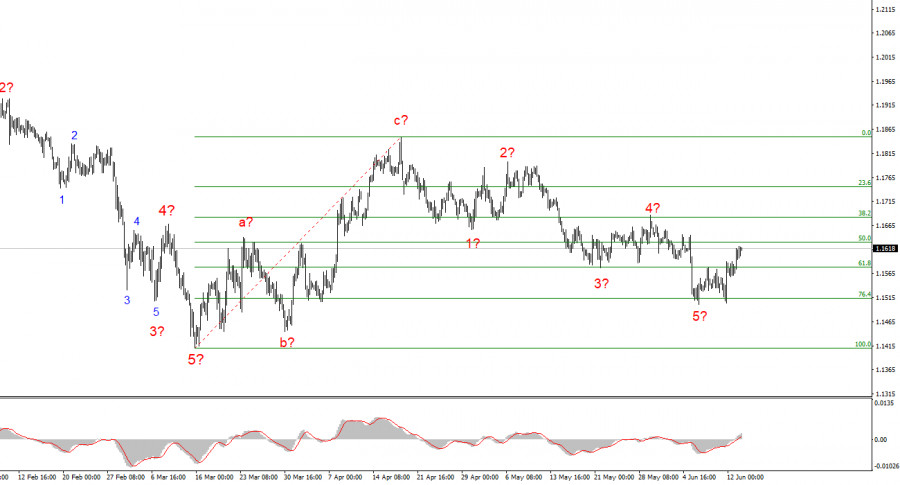
Based on the conducted analysis of EUR/USD, I conclude that the instrument remains within an upward section of the trend, while in the shorter term, it is within a downward section of the trend that may have already completed. In my view, this is a good time to attempt to establish long positions. The unsuccessful attempt to break the 1.1513 mark, corresponding to 76.4% on the Fibonacci, combined with the completed appearance of the downward section of the trend, allows us to suggest a transition of the instrument to an upward wave formation with targets around the 17 figure and higher.
The wave structure of the GBP/USD instrument has become clearer. The instrument has currently constructed three waves down, while the EUR/USD has constructed five. Consequently, the pound may limit itself to constructing a corrective structure, and both currency pairs may begin forming upward sections of the trend. At present, this is merely a hypothesis, but it is a plausible one. If it is correct, the instrument will begin to rise with targets around the 35 figure and above. Market participants now have a good opportunity to buy.
PAUTAN SEGERA
ForexMart is authorized and regulated in various jurisdictions.
(Reg No.23071, IBC 2015) with a registered office at First Floor, SVG Teachers Co-operative Credit Union Limited Uptown Building, Corner of James and Middle Street, Kingstown, Saint Vincent and the Grenadines
Restricted Regions: the United States of America, North Korea, Sudan, Syria and some other regions.










 Hubungi Kami