The euro is rising against the US dollar, although European economic data have provided little reason for such gains. The main driver is the United States. The Democrats' election victory
The euro is rising against the US dollar, although European economic data have provided little reason for such gains. The main driver is the United States. The Democrats' election victory and their control of both chambers of Congress have weakened the US dollar and pushed US Treasury yields lower.
The European economic picture remains weak. The final composite Purchasing Managers' Index (PMI) for October came in at 51.7, below the forecast of 51.9 and September's reading of 53.1. It was also the lowest level in four months. In the services sector, the index fell to 51.4 from the expected 51.7, while France once again recorded a contraction in business activity. New orders showed almost no growth, companies began reducing their workforces for the first time since May, and business confidence fell to its lowest level since May.
At the same time, prices are rising at a faster pace. Consumer inflation accelerated to 4.0% in October from 3.8%, exactly in line with analysts' expectations. This means that economic growth is slowing while prices are rising faster, an unfavorable combination for the currency. The euro's current strength is driven not by its own economic fundamentals but by US dollar weakness. Therefore, any renewed demand for safe-haven assets could leave the single currency vulnerable.
Market attention is now turning to the United States. The services sector PMI and the composite PMI are due today. Both indicators are expected to match their preliminary readings of 57.9 and 57.6, respectively, compared with 58.8 and 58.4 in September. The market has therefore already priced in a modest slowdown. The most important release will be the ISM Services PMI, which is forecast to remain at 54.9, unchanged from September, compared with 55.4 in August. Another report will cover September's international trade balance, with the trade deficit expected to widen to $107.9 billion from $105.6 billion in August.
If the ISM reading exceeds expectations, the US dollar could recover some of its losses, as a strong economy supports expectations for Federal Reserve interest rates and Treasury yields. Conversely, a weaker result would extend the dollar's decline that began after the elections, allowing the euro to maintain its advantage. A wider trade deficit would also put some downward pressure on the US dollar, as it indicates stronger demand for foreign goods and currencies.
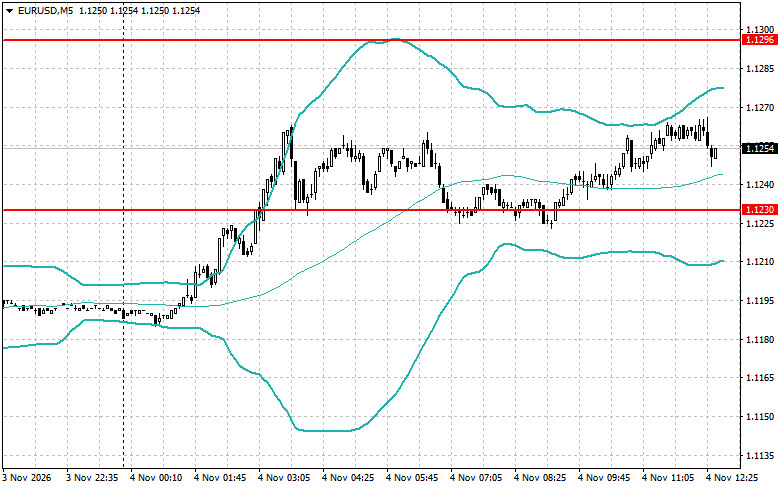
This strategy focuses on breakouts, meaning that the price is expected to move beyond a key level and hold above or below it. The euro could advance toward 1.1298 and 1.1336 following a sustained break above 1.1259. The price is already trading near this level and has made several attempts to move higher, but has failed to hold above it. Therefore, a brief test of the level would not be sufficient to confirm the breakout.
For a bearish scenario, the price would need to consolidate below 1.1227. In this case, a decline toward 1.1200 and 1.1172 would become likely. Until the US economic data are released, it is advisable to avoid premature conclusions, as any price movement could prove to be a temporary spike.
The underlying principle of this strategy is that when the price moves significantly away from its average value, it tends to return toward it. The key levels are 1.1296 and 1.1230. Selling opportunities are considered near the upper level, while buying opportunities are considered near the lower level, with the expectation of a retracement toward the middle of the range.
The price would need to cover considerable ground and break above its recent high to reach the upper level, which would require strong upward momentum. The lower level is located in an area where the price previously found support and reversed higher during the day.

ລິ້ງດ່ວນ
ForexMart is authorized and regulated in various jurisdictions.
(Reg No.23071, IBC 2015) with a registered office at First Floor, SVG Teachers Co-operative Credit Union Limited Uptown Building, Corner of James and Middle Street, Kingstown, Saint Vincent and the Grenadines
Restricted Regions: the United States of America, North Korea, Sudan, Syria and some other regions.









 ຕິດຕໍ່ພວກເຮົາ