Trade analysis and trading advice for the Japanese yen
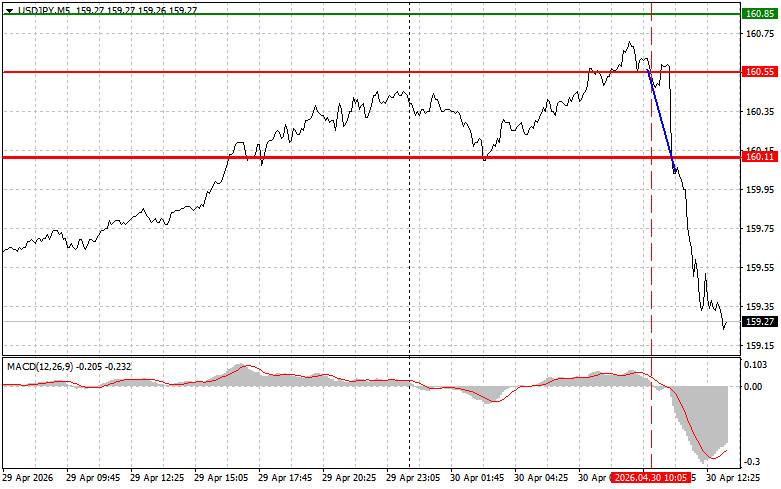
The price test at 160.55 occurred at a moment when the MACD indicator had just begun moving downward from the zero line, which confirmed a correct entry point for selling the dollar. As a result, the pair dropped sharply toward the target level of 160.11.
A clear and decisive intervention by the Japanese regulator aimed at stabilizing the national currency led to a sharp decline in USD/JPY during the first half of the trading day. Actions by the Bank of Japan, including direct interventions in the foreign exchange market, sent a clear signal to the market that further weakening of the yen is unacceptable. The scale and timing of these measures shocked many market participants, who had clearly underestimated the authorities' willingness to defend their position.
Until that moment, USD/JPY had shown steady growth, reflecting significant concerns over the geopolitical crisis in the Middle East.
In the second half of the day, increased attention is expected on upcoming U.S. economic data, including first-quarter GDP figures. In addition, key importance will be placed on the core Personal Consumption Expenditures (PCE) index, as well as changes in household income and spending. These macroeconomic indicators traditionally shape investor sentiment and therefore influence financial market behavior.
In particular, consumer spending data, which makes up a significant share of GDP, will provide insight into the strength of domestic demand. If consumer spending comes in higher than expected, it may be seen as a sign of economic resilience. The core PCE price index is equally important, as the Federal Reserve considers it its primary inflation indicator. Its rise may strengthen expectations of a continued hawkish Fed stance. Changes in personal income also play a key role in determining purchasing power and, consequently, economic growth. Strong income growth can offset a potential slowdown in consumer spending caused by inflation.
Regarding the intraday strategy, I will focus mainly on scenarios No. 1 and No. 2.
Buy Signal
Scenario No. 1: I plan to buy USD/JPY today at around 159.55 (green line on the chart), targeting a rise toward 160.37 (thicker green line). At 160.37, I will exit buy positions and open sell positions in the opposite direction (expecting a 30–35 point pullback). Growth in the pair today is possible if U.S. data is strong. Important! Before buying, ensure that the MACD indicator is above the zero line and has just started rising from it.
Scenario No. 2: I will also consider buying USD/JPY if there are two consecutive tests of 159.10 while the MACD is in oversold territory. This would limit downward potential and trigger a reversal upward. Growth toward 159.55 and 160.37 can then be expected.
Sell Signal
Scenario No. 1: I plan to sell USD/JPY after a break below 159.10 (red line on the chart), which would lead to a sharp decline. The key target for sellers will be 158.44, where I will exit short positions and immediately consider buying in the opposite direction (expecting a 20–25 point rebound). Selling pressure may return today if U.S. data is weak. Important! Before selling, ensure that the MACD is below the zero line and has just started declining from it.
Scenario No. 2: I will also consider selling USD/JPY if there are two consecutive tests of 159.55 while the MACD is in overbought territory. This would limit upward potential and trigger a downward reversal. A decline toward 159.10 and 158.44 can then be expected.
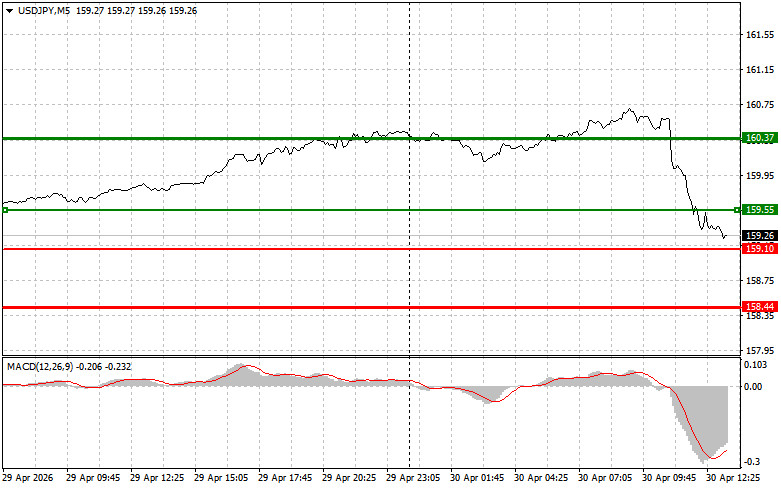
What is shown on the chart:
Important note: Beginner Forex traders should make market entry decisions very carefully. Before major fundamental reports are released, it is best to stay out of the market to avoid sharp price volatility. If you decide to trade during news events, always use stop-loss orders to minimize losses. Without stop-loss orders, you can quickly lose your entire deposit, especially if you do not use proper money management and trade large volumes.
And remember, successful trading requires a clear trading plan, like the one presented above. Spontaneous trading decisions based on current market conditions are a losing intraday strategy from the outset.

QUICK LINKS
ForexMart is authorized and regulated in various jurisdictions.
(Reg No.23071, IBC 2015) with a registered office at First Floor, SVG Teachers Co-operative Credit Union Limited Uptown Building, Corner of James and Middle Street, Kingstown, Saint Vincent and the Grenadines
Restricted Regions: the United States of America, North Korea, Sudan, Syria and some other regions.


















 Contact Us