The price test at 1.1191 occurred as the MACD indicator began moving down from the zero mark, confirming the right entry point to sell the euro. As a result
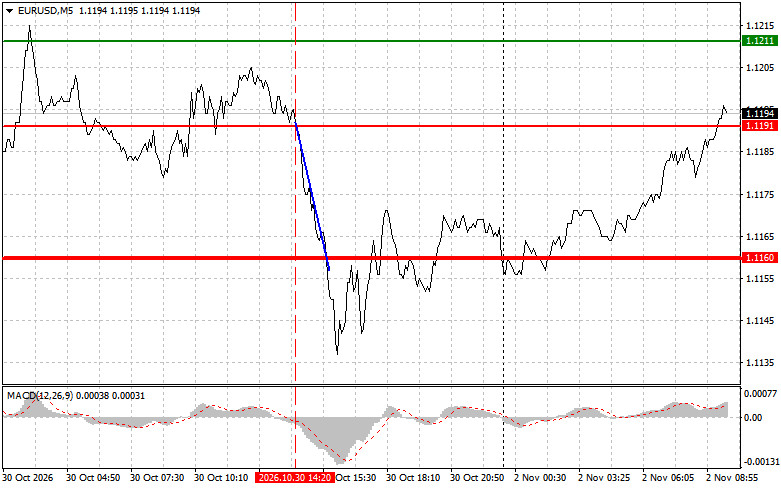
The price test at 1.1191 occurred as the MACD indicator began moving down from the zero mark, confirming the right entry point to sell the euro. As a result, the pair moved toward the target area of 1.1160.
Friday was a decline for the euro. The reason was the words of two Federal Reserve representatives, spoken one after the other, and both remarks were noticeably harsher than what the market had heard after the October 28 meeting. Eurozone GDP also disappointed, as did Germany's inflation data. Alberto Musalem of the St. Louis Fed said rates need to rise in the near term because inflation remains too high and will not fall on its own. Tom Barkin of the Richmond Fed completed the picture. In his view, policy direction is already clear; only the pace remains to be discussed. The euro in this story depended on two factors at once. The European Central Bank left rates unchanged last week; the main rate remained at 2.65% and the deposit rate at 2.50%, and the market still prices in one final hike to 2.75% in December. Moreover, as I noted above, eurozone GDP in the third quarter was not that strong.
The first half of today promises to be busy for the euro, although forecasts do not imply surprises. The German manufacturing purchasing managers' index for October is expected at 54.2 points, unchanged from the previous period, and for the eurozone the forecast is 52.4 points, also unchanged. These figures suggest the region's industry remains stable amid expensive energy and high rates. For the market, other factors matter more. If the actual readings are higher, the euro will receive support because this will strengthen expectations of an ECB rate hike to 2.75% in December, while a weak result would, by contrast, undermine that logic.
Meanwhile, Bundesbank President Joachim Nagel will speak, and his words will be closely watched. I recall his position at the IMF meeting on October 16. Nagel said that after two rate hikes, further steps cannot be ruled out if the situation does not change, and he acknowledged that the market prices in a 25-basis-point hike in December. I believe that if the figures for Germany and the eurozone match forecasts and Nagel maintains a hawkish tone, EUR/USD can continue rising, but without a positive surprise, the recovery will be slow.
As for the intraday strategy, I will rely more on scenarios No. 1 and No. 2.
Scenario No. 1: Today, you can buy the euro when the price reaches around 1.1200 (green line on the chart), with a target of rising to 1.1232. At 1.1232, I plan to exit the market and also sell the euro in the opposite direction, expecting a move of 30–35 pips from the entry point. Expecting euro growth today is possible only after good data. Important! Before buying, make sure the MACD indicator is above the zero line and is just beginning to rise from it.
Scenario No. 2: I also intend to buy the euro today if it tests 1.1183 twice in a row while the MACD indicator is in the oversold area. This will limit the pair's downside potential and lead to an upward reversal. You can expect a rise to the opposite levels of 1.1200 and 1.1232.
Scenario No. 1: I plan to sell the euro after reaching the 1.1183 level (red line on the chart). The target will be 1.1157, where I plan to exit the market and immediately buy in the opposite direction (expecting a 20–25 pip move in the opposite direction from the level). Pressure on the pair will return in case of weak data. Important! Before selling, make sure the MACD indicator is below the zero line and is just beginning to fall from it.
Scenario No. 2: I also intend to sell the euro today in the case of two consecutive tests of 1.1200 when the MACD indicator is in the overbought area. This will limit the pair's upside potential and lead to a downward reversal. You can expect a decline to the opposite levels of 1.1183 and 1.1157.
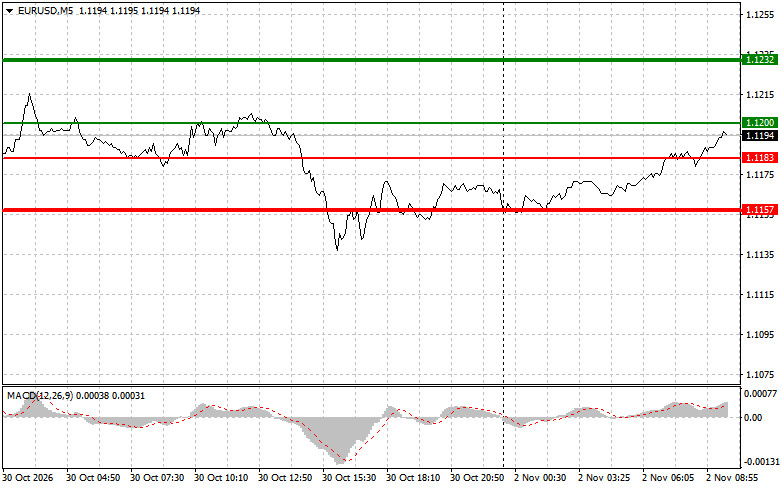
Thin green line – the entry price at which you can buy the trading instrument;
Thick green line – the suggested price where you can place a Take Profit or manually lock in gains, since further upside above this level is unlikely;
Thin red line – the entry price at which you can sell the trading instrument;
Thick red line – the suggested price where you can place a Take Profit or manually lock in gains, since further downside below this level is unlikely;
MACD indicator. When entering the market, it is important to follow the overbought and oversold zones.
Important. Beginner Forex traders must be very cautious when making entry decisions. Before the release of important fundamental reports, it is best to stay out of the market to avoid getting caught in sharp price swings. If you decide to trade during news releases, always place stop orders to minimize losses. Without stop orders, you can quickly lose your entire deposit, especially if you don't use money management and trade large volumes.
Remember, successful trading requires a clear trading plan, like the example I presented above. Spontaneous trading decisions based on the current market situation are a losing strategy for an intraday trader from the start.
ForexMart is authorized and regulated in various jurisdictions.
(Reg No.23071, IBC 2015) with a registered office at First Floor, SVG Teachers Co-operative Credit Union Limited Uptown Building, Corner of James and Middle Street, Kingstown, Saint Vincent and the Grenadines
Restricted Regions: the United States of America, North Korea, Sudan, Syria and some other regions.









 আমাদের সাথে যোগাযোগ করুন