For the US currency, the current week may become quite gloomy. Recall that in recent months, the dollar has often received strong market support due to the geopolitical conflict in the Middle East. Market participants frequently sought refuge from risks in the US dollar, leading to its regular appreciation. However, times are changing. Iran and the US may sign a peace agreement by the end of the week, opening the Strait of Hormuz. Therefore, demand for the US currency is unlikely to rise this week unless the deal is canceled at the last moment.
Also, on Wednesday evening, the Federal Reserve will hold its meeting—the first with new chair Kevin Warsh. How important is this event, and what should traders expect? This is perhaps the most difficult question at the moment. Personally, I continue to believe that Warsh was appointed by Trump to prevent the FOMC from raising interest rates. Consequently, Warsh will likely do everything he can to influence his colleagues and convince them that there is no need to tighten monetary policy. Whether he succeeds is unknown, but the end of the conflict in the Middle East could add credibility to the views of the new Fed chair.
If the war between Iran and the US ends, inflation may indeed begin to slow. The question is how much it will slow without Fed intervention. Will it return to pre-war levels? However, it is too early to discuss all this; we need to wait for the conflict to be resolved first.
Thus, on Wednesday evening, the Fed is unlikely to adopt a "hawkish" stance. Consequently, the dollar will not gain market support, and, according to the CME FedWatch tool, the probability of a rate hike by the end of the year has already decreased from 70% to 50%. It is likely that by Friday, this probability will drop even further. If Warsh announces after the meeting that a rate hike is unnecessary, demand for the US currency may decline sharply, as the market has recently been actively pricing in tighter policy.
Based on all of the above, the chances of the dollar strengthening this week are low. In my view, the dollar has risen sufficiently in recent months, although it has not shown significant strengthening against the euro and the pound.
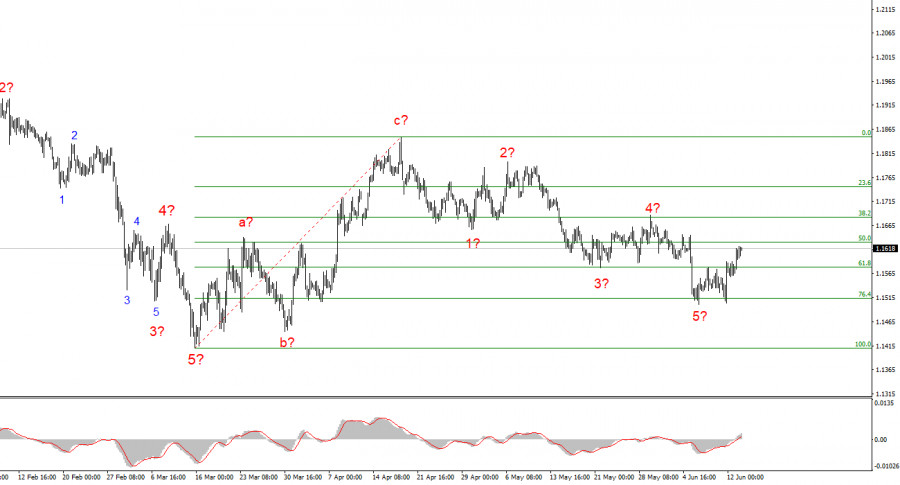
Based on the analysis of EUR/USD, I conclude that the instrument remains within an upward section of the trend, while in the shorter term, it is within a downward section of the trend that may already be complete. In my opinion, this is a good time to attempt to establish long positions. The unsuccessful attempt to break the 1.1513 mark, corresponding to 76.4% on the Fibonacci scale, combined with the completed appearance of the downward section of the trend, allows us to suggest a transition of the instrument to an upward wave formation with targets around the 17 figure and higher.
The wave structure of the GBP/USD instrument has become clearer. The instrument has currently constructed three waves down, while the EUR/USD has constructed five. Consequently, the pound may limit itself to constructing a corrective structure, and both currency pairs may begin forming upward sections of the trend. At this moment, this is merely a hypothesis, but it is a plausible one. If it is correct, the instrument will begin to rise with targets around the 35 figure and above. Market participants currently have a good opportunity to buy.
QUICK LINKS
ForexMart is authorized and regulated in various jurisdictions.
(Reg No.23071, IBC 2015) with a registered office at First Floor, SVG Teachers Co-operative Credit Union Limited Uptown Building, Corner of James and Middle Street, Kingstown, Saint Vincent and the Grenadines
Restricted Regions: the United States of America, North Korea, Sudan, Syria and some other regions.













 Contact Us