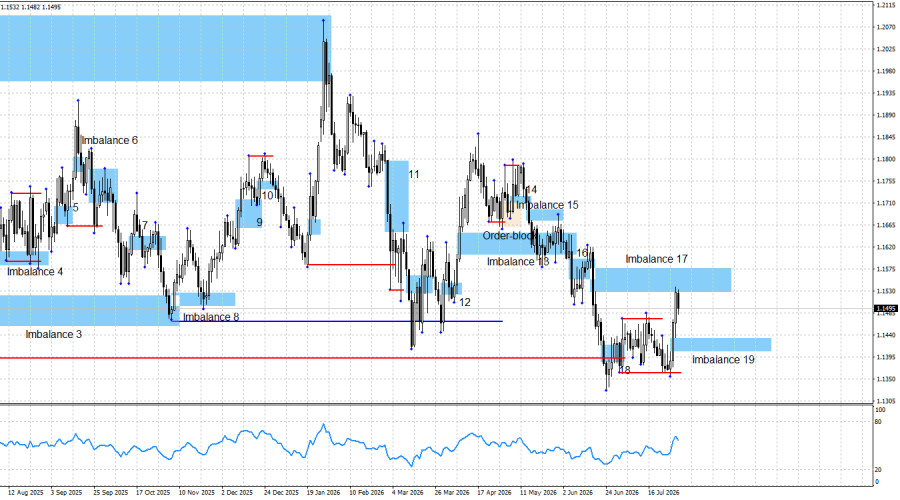
The EUR/USD pair remains within the local bearish impulse that has been in place since April 17. Today, the pair reacted to Imbalance 17, as I had been anticipating for quite some time, and resumed its decline. As a result, we saw a strong rally in the euro on Wednesday and Thursday, followed by a sharp sell-off on Friday, driven by both the news flow and a technical signal.
As a reminder, on Wednesday evening Kevin Warsh once again highlighted the problem of elevated inflation in the United States but was not sufficiently convincing when explaining the Federal Reserve's next steps. Traders had expected Warsh to deliver either a clear indication of a September rate hike or, at the very least, more hawkish rhetoric that would answer the key question: Is the Federal Reserve prepared to tighten monetary policy this autumn? Instead, Warsh referred to incoming economic data, and, as we all know, the latest U.S. labor market figures were relatively weak. Consequently, Warsh may argue in September that labor market conditions do not justify a rate hike. As a result, the bulls received unexpected support, completed another liquidity sweep, and launched a fresh advance. On Thursday, they were further supported by strong Eurozone economic data and weak U.S. figures. On Friday, however, the single inflation report from the Eurozone triggered a sharp decline in the euro, as the July reading merely met market expectations.
It should be remembered that expectations of Federal Reserve monetary tightening are merely market expectations and can change as geopolitical conditions evolve. The latest U.S. labor market data was relatively weak, while the inflation report pointed to slower price growth. Consequently, the slowdown in both the labor market and inflation raises doubts about whether the FOMC will raise interest rates in the foreseeable future. Personally, I am not convinced that the Federal Reserve will necessarily begin tightening monetary policy this year, nor that any potential rate increase would be anything more than a one-off move designed to avoid provoking Donald Trump excessively.
Geopolitical developments remain a secondary factor but continue to influence the economy. Tehran and Washington have withdrawn from the June 17 agreement, Donald Trump has reinstated sanctions on Iranian oil and restored the blockade of Iranian shipping, while Iran has once again closed the Strait of Hormuz and is attacking vessels attempting to pass through it outside what it considers the established rules. A month ago, we did not see the U.S. dollar weaken as geopolitical tensions eased, nor did we see the euro strengthen following the ECB's monetary tightening one and a half months ago. The bears remain in control despite the broader fundamental and geopolitical backdrop. In my opinion, deteriorating relations between Iran and the United States alone are no longer sufficient to trigger another sustained bearish move.
The current technical picture continues to indicate that the bearish impulse that began on April 17 remains intact. Bearish Imbalance 17 was fully tested yesterday and today, generating a sell signal. The question now is how deep the euro's decline will become. Yesterday, a new Bullish Imbalance 19 formed, giving the bulls renewed reason for optimism. Therefore, the decline may continue until this pattern is reached, where a new buy signal could emerge and allow the bullish advance to resume.
Friday's economic releases were significant and were the primary driver behind the euro's decline. Germany's inflation report had led market participants to expect a stronger-than-forecast inflation reading for the Eurozone as a whole. In reality, however, Eurozone inflation increased by only 0.1 percentage points, matching market expectations. As a result, the European Central Bank may decide to extend its pause in monetary policy tightening at its September meeting.
The bulls still have plenty of reasons to remain optimistic in 2026, and even the conflict in the Middle East has not significantly altered that broader outlook. Structurally and fundamentally, Donald Trump's policies—which contributed to the sharp decline in the U.S. dollar last year—have not changed. At present, I do not see any major long-term support factors for the U.S. dollar despite the FOMC's hawkish stance. Nevertheless, it is still the bears who remain on the offensive, while no bullish technical signals have yet emerged.
Germany
United States
The economic calendar for August 3 contains two scheduled releases, with the ISM Manufacturing PMI standing out as the most important. As a result, the economic backdrop is likely to influence market sentiment mainly during the second half of Monday's trading session.
In my opinion, the pair remains in the process of forming a broader bullish trend. Although the fundamental backdrop shifted sharply in favor of the bears five months ago, the longer-term trend cannot yet be considered cancelled or complete. Therefore, the bulls may launch another advance after the two recent liquidity sweeps below key swing lows.
At present, Bearish Imbalance 17 continues to provide a valid sell signal. Therefore, the euro may continue declining next week with Bullish Imbalance 19 serving as the downward target. Once the price reaches Imbalance 19, a new buy signal may emerge, allowing traders to consider long positions with targets above 1.1620.
RYCHLÉ ODKAZY
ForexMart is authorized and regulated in various jurisdictions.
(Reg No.23071, IBC 2015) with a registered office at First Floor, SVG Teachers Co-operative Credit Union Limited Uptown Building, Corner of James and Middle Street, Kingstown, Saint Vincent and the Grenadines
Restricted Regions: the United States of America, North Korea, Sudan, Syria and some other regions.



















 Kontaktujte nás